Break-Even ROAS: The Formula, With Returns and a Worked Example
Break-even ROAS is 1 divided by your margin, but only if the margin is honest. The formula with shipping, payment fees and returns, worked through in dollars.
On this page
Break-even ROAS is the return on ad spend at which an ad campaign neither makes nor loses money: 1 divided by your contribution margin as a share of revenue. With a 40% margin, break-even ROAS is 2.5x. The catch is the margin: it must take out product cost, shipping, payment fees, sales tax or VAT, and returns. For brands with a high return rate, returns usually push break-even ROAS well above what people expect.
Key takeaways
- Break-even ROAS = 1 ÷ contribution margin (as a decimal). A 50% margin means 2x.
- Use contribution margin after product cost, shipping, payment fees and returns, not gross margin.
- Returns raise break-even ROAS twice: they lower the revenue you keep and add return shipping.
- Compare break-even ROAS with true ROAS (after returns), not with Ads Manager ROAS.
- Your target ROAS should sit above break-even by the profit you want, or below it on purpose when buying new customers.
The formula
Return on ad spend is revenue divided by ad spend. A campaign breaks even when the margin it earns on that revenue exactly pays for the ads:
Revenue × contribution margin = ad spend
Rearranged:
Break-even ROAS = 1 ÷ contribution margin
So a product that leaves 40% of its price after all variable costs breaks even at 1 ÷ 0.40 = 2.5x. Every dollar of ads needs $2.50 of revenue to pay for itself.
What goes into contribution margin
Gross margin (price minus product cost) is not enough. Contribution margin takes off every cost that grows with each order:
| Cost per order | Include? | Why |
|---|---|---|
| Product cost (COGS) | Yes | The biggest variable cost |
| Packaging | Yes | Paid on every parcel |
| Forward shipping | Yes | Paid on every shipped order |
| Payment fees | Yes | Usually 2–3% of order value, often plus a small fixed fee |
| Sales tax or VAT on the sale | Yes, take it out of revenue | It is collected for the government, not earned |
| Discounts | Yes | Take them out of revenue |
| Returns and refunds (lost revenue and return shipping) | Yes | Covered in its own section below |
| Rent, salaries, software | No | Fixed costs: they don't change with one more order |
Fixed costs matter for the business, but they don't belong in break-even ROAS. They are what your total contribution, across all orders, has to cover each month.
A worked example in dollars
The numbers here are an illustration. A product sells for $50 once any sales tax or VAT is taken out:
- Revenue: $50
- Product cost: $15
- Packaging: $1.50
- Forward shipping: $3.50
- Payment fees: $1.25
Contribution margin before returns: $28.75, or 57.5%. Break-even ROAS before returns: 1 ÷ 0.575 = 1.74x.
That looks comfortable. Now add returns.
How returns change break-even ROAS
Suppose 16% of shipped orders come back and are refunded. On each of those:
- You refund the $50 of revenue.
- You still paid packaging and forward shipping ($5), and you pay $3.50 of return shipping: $8.50 in all.
- The product comes back, so product cost is not lost (unless it is damaged). If your payment provider keeps its fee on refunds, add that too.
Per 100 orders shipped, with these numbers:
- 84 kept orders earn 84 × $28.75 = $2,415 of margin.
- 16 returns cost 16 × $8.50 = $136 in shipping and packaging.
- Net contribution: $2,279 on revenue kept of $4,200.
But the ad platform counts all 100 orders, $5,000 of revenue. So measured against what Ads Manager reports, your margin is $2,279 ÷ $5,000 = 45.6%, and break-even platform ROAS is 1 ÷ 0.456 = 2.19x, not 1.74x.
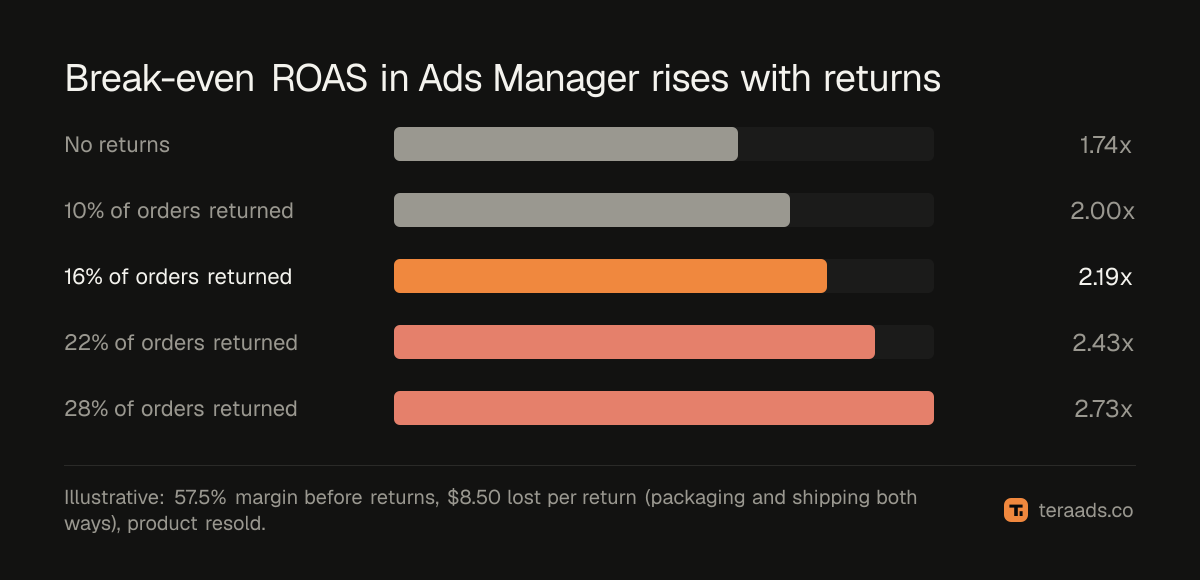
At a 22% return rate the break-even platform ROAS in this example rises to about 2.4x. A campaign that reports 2.3x in Ads Manager can look profitable while losing money on every dollar. In cash-on-delivery markets such as India, count parcels returned to origin (RTO) as returns too.
Two ways to use the number
There are two consistent ways to compare, and mixing them is the most common mistake:
- True ROAS vs margin on kept orders. Measure ROAS on kept revenue, after returns, as explained in true ROAS after returns, and compare it with break-even using the margin on kept orders minus return costs.
- Platform ROAS vs margin on attributed revenue. If your team lives in Ads Manager, use the returns-adjusted break-even above (2.19x in the example) as the floor.
Either works. Comparing Ads Manager ROAS with a margin that ignores returns does not.
From break-even to target ROAS
Break-even is the floor, not the goal. A target ROAS adds the profit you want from each dollar of ads:
Target ROAS = 1 ÷ (contribution margin − desired profit margin)
With a 45.6% returns-adjusted margin and a goal of 15% profit on revenue, target ROAS = 1 ÷ (0.456 − 0.15) = 3.27x.
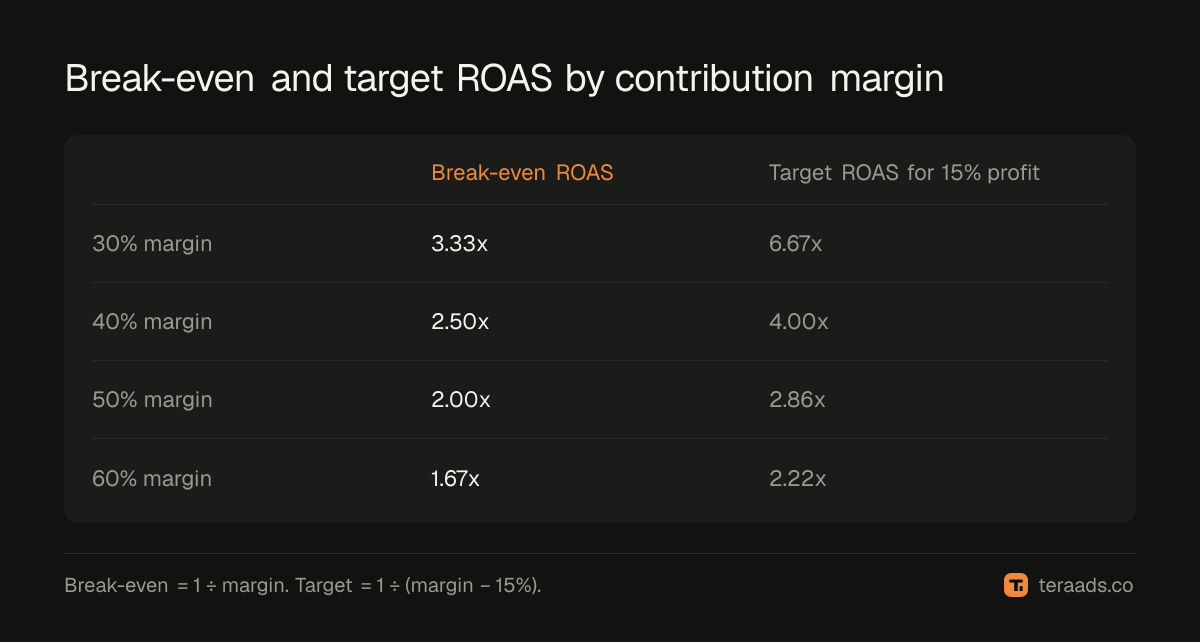
There are good reasons to run some campaigns below break-even on purpose. Prospecting campaigns that win first orders from customers who come back often can lose money on the first order and still be profitable over the customer's lifetime. If you do this, decide the allowed loss in advance and measure repeat purchases, so a "customer acquisition" campaign doesn't become a polite name for a losing one.
For the account as a whole, many brands set budget against MER instead of ROAS, which avoids attribution arguments between Meta, Google and Shopify.
How to keep break-even ROAS honest
- Recalculate monthly. Shipping rates, discounts, product costs and return rates all move, especially around sale seasons.
- Calculate per product or category if margins differ. A store with 70% margin accessories and 35% margin bestsellers has two very different break-evens.
- Use your real return rate. Borrowed industry averages hide your own problem areas. The returned-parcel cost guide shows how to put a money figure on each parcel that comes back.
- Watch the trend, not one day. Daily ROAS is noisy; judge campaigns on a week or more of spend.
Tera Ads works out profit after ad spend and returns for the whole store on one screen, from your Shopify orders and your Meta Ads and Google Ads spend. It is free for one business. That turns break-even ROAS from a spreadsheet exercise into a number you can check against the store's real results every morning.
Frequently asked questions
What is a good ROAS for a D2C brand?
Any ROAS above your break-even is profitable, so it depends on your margin and your return rate. A brand with high margins and few returns may do well at 2x; a low-margin brand with many returns may need 3x or more in Ads Manager. What is a good ROAS has a table of break-even and target ROAS by margin.
Is break-even ROAS the same as target ROAS?
No. Break-even is the point of zero profit. Target ROAS is break-even plus the profit you want, and it is the number to give your team or to use in value-based bidding.
Should I include sales tax or VAT in revenue when calculating ROAS?
No, and be consistent. Revenue should exclude the sales tax or VAT you collect for the government; where shelf prices include VAT, as in the UK and EU, take it out first. If you can reclaim the tax charged on your ad invoices, use ad spend without it; if you can't, include it.
Does break-even ROAS change during sale seasons?
Yes. Discounts lower your margin, so break-even ROAS rises exactly when ad costs also rise. Recalculate it with sale prices before the season starts.
Why is my ROAS high but my profit low?
Usually because ROAS is measured on placed orders while profit depends on the ones customers keep. High returns, heavy discounts or Meta and Google both claiming the same sale can all make ROAS look better than the business is.